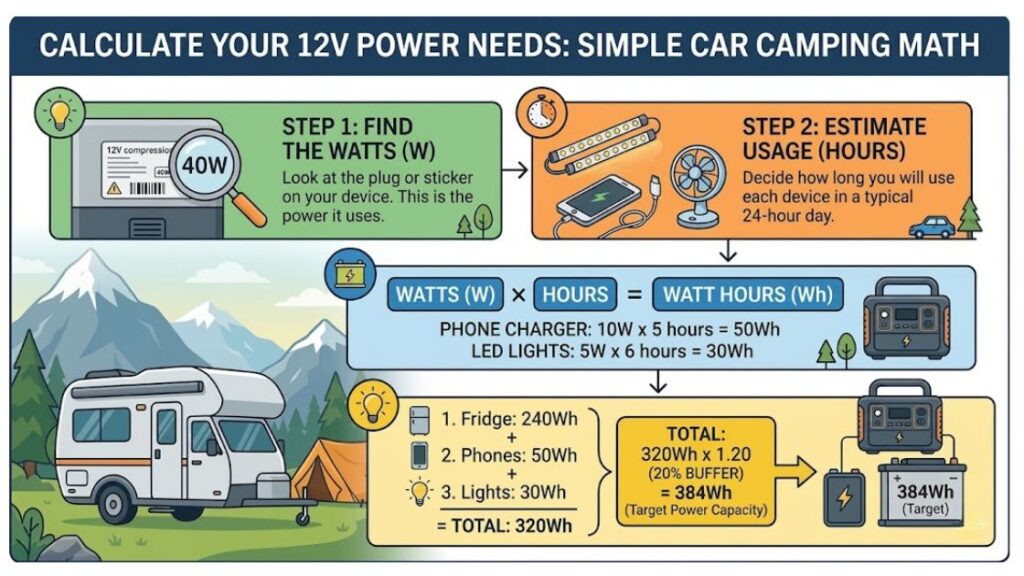
Planning a road trip or vehicle conversion but worried about keeping your fridge running and devices charged? Learning how to calculate 12V power needs is the most important step in building a reliable setup. The absolute biggest mistake people make when setting up a budget micro-camper is guessing what size battery or power station they need. If you guess too small, you end up with a dead battery by Saturday morning; guess too big, and you waste hundreds of pounds on capacity you’ll never use.
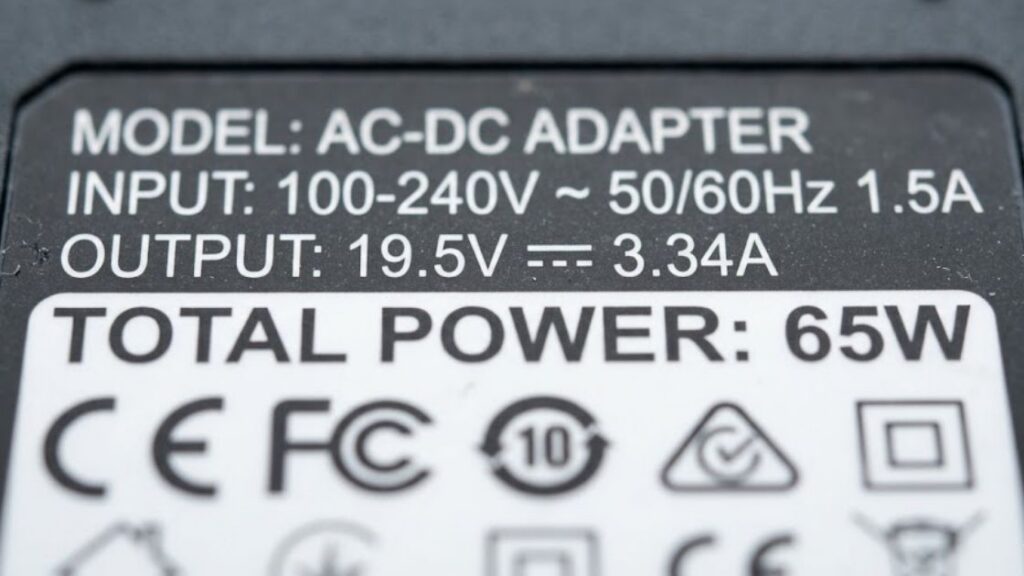
Calculating your electrical needs sounds daunting, but you don’t need to be a mathematician to figure it out. The secret is already right in front of you. To find out exactly how much power any device uses—whether it’s a 12V fridge, a tablet, or a LED light strip—all you have to do is look at the plug or the small sticker on the back of the device. Look for a number next to the letters “W” (Watts) or “A” (Amps). Once you find that number, you have everything you need to run a basic calculation.
Watt Hours vs. Amp Hours: Demystifying the Numbers
When we look at power it may seem complicated, but it’s actually quite simple. One way is far simpler, but with a little knowledge, you will be ready for any setup. Let’s start with Watt Hours. Your standard portable power stations use Watt Hours (Wh), whereas a standard 12V battery uses Amp Hours (Ah).
When you want to calculate 12V power needs, working with Wh is a lot simpler when it comes to the maths. In fact, that simplicity is usually the exact reason why people might pay the extra money for an all-in-one power station option over a traditional DIY 12V build.
The Secret to Fridge Power: The “Rest” Cycle
Let’s look at a 12V compression fridge as a prime example. If you look at the sticker on the back of a standard camping fridge, it might say it uses 40 Watts. But here is the trick: it doesn’t actually draw that much power constantly.
The fridge will rest when the temperature is cold enough, which actually saves power as it’s only running about a quarter of the day even when plugged in. So, instead of drawing a full 40W every single hour, it averages out to just 10W an hour. When you calculate 12V power needs for a full 24-hour day, that means the fridge only eats up about 240 Watt Hours (Wh) total (10×24=240).

How to Calculate 12V Power Needs: Adding It All Together
Now that you know how the maths works, it’s time to look at your entire setup. Make a quick list of everything you plan to bring—think about your phones, lighting, fridge, entertainment (like a tablet or laptop), and maybe a Wi-Fi dongle.
To calculate 12V power needs for your whole trip, it’s simple: just multiply each device’s watts by the hours you know you will be using them, and then add it all together. Once you have that total, it is best to add a 20% buffer just to be safe. You don’t want to get out there and realise you did not accommodate for the fridge or an extra phone charge and find yourself running low on power in the middle of a trip.
If your gear only lists Amps, you can use a quick conversion tool like the Omni Calculator Ohms Law Tool to find your Watts, or just multiply Amps by your system’s voltage (usually 12V).